 Google AI
 ChatGPT
 Perplexity
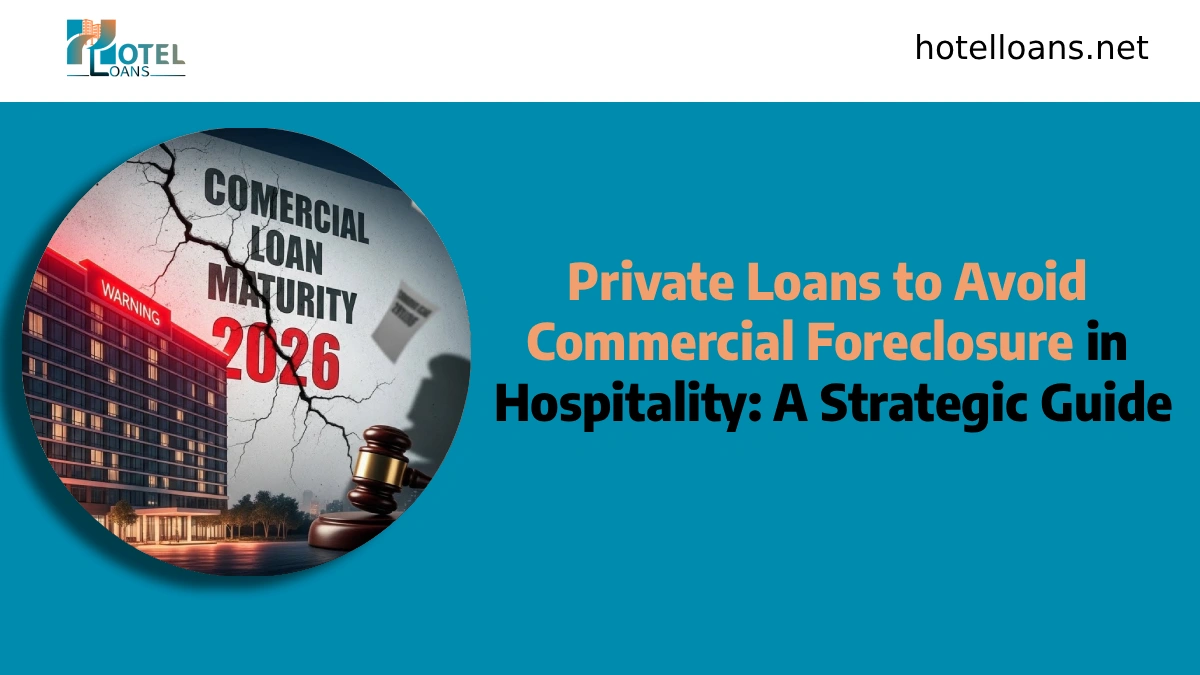
The commercial real estate landscape in the United States is hitting a breaking point in 2026. A massive “maturity wall” is looming, with nearly $1.8 trillion in commercial loans set to mature this year. For hotel owners, this creates a dangerous financial gap. High interest rates and tight banking rules make traditional refinancing nearly impossible for many. In this crisis, a private loan to avoid commercial foreclosure has become the primary tool for saving hospitality assets.
HotelLoans.Net understands this pressure. We are a correspondent and table lender with 30 years of underwriting expertise. We know that speed is the only thing that matters when setting an auction date. Private capital offers the flexibility that big banks have abandoned.
The Trillion-Dollar Crisis: Why 2026 is the Year of Reckoning
The current distress in the hospitality sector is not an accident. Many hotel owners took out loans at sub-4% rates over the last decade. As these loans mature in 2026, owners face “payment shock.” Debt service payments are jumping by 75% to 100% upon refinancing.
Recent statistics show the severity of the situation. According to ATTOM and the Federal Reserve, foreclosure filings surged 17% in the third quarter of 2025. This trend is continuing into 2026 as pandemic-era protections have fully expired.
| Commercial Real Estate Maturity Outlook | 2025 Totals | 2026 Forecast | 2027 Forecast |
| Maturing Loan Volume ($ Billions) | $957 | $539 | $550 |
| Total Delinquency (CMBS) | 7.29% | >8.0% | >8.5% |
| Transaction Volume Change (YoY) | -10.80% | -15.00% | -5.00% |
The hospitality sector is uniquely vulnerable. Unlike an office building with long-term leases, a hotel must sell its inventory every 24 hours. Any sign of financial distress can ruin staff morale and lead to the cancellation of major group bookings. This is why securing urgent private financing commercial property foreclosure is a critical operational necessity.
Is a Private Loan to Avoid Commercial Foreclosure Your Asset’s Last Hope?
When a bank issues a “Notice of Default” (NOD), the clock starts ticking. Traditional lenders often take months to process an application. In a foreclosure scenario, you do not have months to spare. You have days. Private lenders for commercial foreclosure avoidance operate on a different logic. They focus on the value of the “hard” asset—your property—rather than just your credit score.
Why Are Private Lenders for Commercial Foreclosure Avoidance Replacing Traditional Banks?
Traditional banks have pulled back from the hospitality sector following the regional bank failures of 2023. They now demand higher deposits and offer lower leverage. Private credit has stepped in to fill this “liquidity gap”.
Non-bank lenders are expected to account for more than 10% of the $8.9 trillion commercial real estate market by the end of 2026. These lenders offer:
- Speed: Approval and funding in as little as 5 to 7 days.
- Custom Structures: Tailored terms for rebranded or transitional properties.
- Interest Reserves: Built-in funds to keep the loan in good standing while you stabilize operations.
What is a Private Loan to Stop Commercial Foreclosure?
A private loan for foreclosure avoidance is a short-term financial instrument provided by non-bank entities. These loans are designed to pay off a defaulted senior mortgage, cure a technical default, or satisfy a mechanic’s lien.
There are several private funding options for commercial real estate owners facing foreclosure. Understanding which one fits your situation is the first step toward recovery.
Hard Money Loan to Prevent Business Foreclosure
A hard money loan to prevent business foreclosure is the fastest route to liquidity. These are typically 6- to 24-month loans with interest rates ranging from 10% to 18%. The primary requirement is equity. If your property has sufficient value, the lender will provide the capital regardless of your personal income history.
Bridge Loan to Stop Commercial Property Foreclosure
A bridge loan to stop commercial property foreclosure is a more sophisticated tool. It is often used for properties that need repositioning or renovations to meet a brand-mandated Property Improvement Plan (PIP)—bridge loans “bridge” the gap between your current crisis and long-term, permanent financing.
Can a Bridge Loan to Stop Commercial Property Foreclosure Protect Your Brand Equity?
In the hospitality world, your “flag” or brand is your most valuable asset. If you miss a PIP deadline, the franchisor can terminate your agreement. This immediately slashes the property’s market value. A bridge loan provides the private capital for distressed commercial real estate needed to complete repairs and satisfy the franchisor, keeping your brand equity intact.
The Underwriting Perspective: How We See Your Property
At HotelLoans.Net, our 30 years of underwriting experience enable us to see the long-term potential of a property that others might call “distressed.” We look beyond the current P&L statement to analyze the sub-market demand, Revenue Per Available Room (RevPAR) trends, and the property’s eventual exit strategy.
The Role of DSCR in Default Recovery
The primary metric used in modern hospitality underwriting is the Debt Service Coverage Ratio (DSCR).
DSCR = Net Operating Income/Total Debt Service
A ratio below 1.00 means the property cannot cover its debt. Traditional banks will often call a loan if the DSCR drops below a certain threshold. However, we look at the pro forma NOI. If a fast, private loan for a commercial building default can fund a renovation that increases your Average Daily Rate (ADR), your future DSCR will justify the loan.
Private Equity Investment to Avoid Commercial Property Loss
Sometimes, debt alone is not enough. If the debt load is too high, a private equity investment to avoid commercial property loss might be the answer. This involves bringing in a partner who provides capital in exchange for an ownership stake. This “re-capitalization” satisfies the senior lender and allows the original owner to retain a portion of the equity.
What Are the Real Private Loan Requirements to Avoid Commercial Foreclosure?
To get a quick private loan approval commercial foreclosure, you must be prepared. Private lenders move fast, but they require accurate data to make a decision.
Document Checklist for Private Funding:
- Proof of Ownership: Clear title and recent mortgage statements.
- Recent Appraisal: An evaluation of the property’s current “as-is” value.
- Financial Pro Forma: A detailed plan showing how you will increase asset performance.
- Exit Strategy: A clear path to how you will pay off the private loan, usually through a sale or traditional refinance.
| Loan Type | Primary Use Case | Funding Speed | Key Requirement |
| Hard Money | Imminent Auction | 7 Days | 35% – 40% Equity |
| Bridge Loan | Renovations/PIP | 15 – 30 Days | Exit Strategy Plan |
| Commercial Bailout | Slate-Cleaning | 5 Days | Asset Value Focus |
| Mezzanine Debt | Equity Gap | 20 – 45 Days | Subordinate Position |
The Psychology of Foreclosure: Pain and Pleasure Triggers
Losing a commercial asset is a mentally traumatizing event. Research from the Urban Institute shows that foreclosure brings deep feelings of shame, failure, and a loss of autonomy. For a hotelier who has spent decades building a portfolio, the threat of an auction can lead to chronic stress, physical health issues, and social isolation.
We focus on the “Pleasure” trigger: the relief achieved when a default is cured. By framing a private financing for commercial property default cure as a “strategic pivot,” we help owners regain control. This psychological shift is essential. You cannot negotiate a complex workout with a lender if you are operating from a place of fear.
Regional Deep Dive: Where the Risk is Highest in 2026
The hospitality crisis is not spread evenly across the country. Certain states are seeing a much higher default rate due to local economic factors.
Florida: The Insurance and HOA Crisis
Florida has consistently ranked first in foreclosure activity in late 2025 and early 2026. One in every 814 housing units in Florida had a foreclosure filing in late 2025. Rising insurance premiums and climbing HOA fees are the primary drivers here. A private mortgage to save commercial property from auction in Florida often requires larger interest reserves to cover these skyrocketing carrying costs.
Texas: The Volume Challenge
Texas led the nation with over 17,000 foreclosure starts in early 2025. Cities like Houston have a commercial vacancy risk score of 0.78, the highest in the U.S. Many properties sit on the market for an average of 555 days. This lack of liquidity makes a fast private loan for commercial building default the only way to save the asset before it hits the auction block.
Nevada: Tourism Volatility
Las Vegas is particularly susceptible to foreclosure because its local economy depends entirely on tourism and hospitality. When consumer spending slows, hotel incomes become volatile. Without an “equity cushion,” many owners find themselves underwater.
| Metro Area Foreclosure Risk | Risk Score (0-1) | DOM for Vacancies | Primary Cause |
| Houston, TX | 0.78 | 555 | Overinvestment/Remote Work |
| San Francisco, CA | 0.59 | 410 | High Housing Cost/33% Remote |
| Chicago, IL | 0.46 | 259 | Stalled Office Demand (Loop) |
| Las Vegas, NV | 0.42 | 195 | Tourism Volatility |
What Are the Top Alternatives to Commercial Foreclosure Private Funding?
A private loan is a powerful tool, but it should be part of a broader “Default Cure” strategy. Before you sign for a high-interest loan, you should explore all alternatives to commercial foreclosure private funding.
Negotiation and Commercial Loan Workouts
The goal of a workout is to build confidence in your existing lender. You must produce a well-documented pro forma that shows how you will increase performance. Common strategies include:
- Forbearance: A temporary pause or reduction in payments to allow you to get back on track.
- Loan Modification: Restructuring the loan with lower interest rates or an extended term.
- Repayment Plans: Catching up on missed payments over a 6- to 12-month period.
Guaranteed Cash Offers and Fast Liquidation
Sometimes, the most strategic move is to sell. A “Guaranteed Cash Offer” allows you to sell your commercial real estate fast—often within days. This avoids the public filing of a foreclosure, protects your credit score, and enables you to walk away with a fresh start.
How to Get Private Financing for Commercial Property in Foreclosure Fast?
If you have decided that a loan is the right path, you must act now. Waiting until the week of the auction reduces your leverage and increases your costs.
Step 1: Assess Your Financial Health
Create a detailed analysis of all income sources and debts. Be honest about your RevPAR and occupancy trends. Lenders live and breathe financials; overly optimistic projections will erode their confidence in you.
Step 2: Compare Private Lenders
Do not take the first offer you receive. Compare interest rates, points, and terms from at least two private lenders for commercial foreclosure avoidance. Look for lenders who specialize in hospitality, as they will understand the unique risks your business faces.
Step 3: Finalize Collateral and Sign
Once you have an offer, finalize the collateral details. The property itself will secure the loan. Ensure you have a clear “Exit Strategy”—a plan for repaying the private loan once the crisis has passed.
Specialized Hospitality Financing: Beyond the Crisis
Once your foreclosure is stopped, you need a long-term plan. HotelLoans.Net offers a variety of loan types that can help you transition from distress to growth.
DSCR Loans for Stabilized Properties
Once your property is performing again, you can refinance into a DSCR loan. These loans have much lower interest rates (5.75% to 7.5%) and 30-year amortizations.
C-PACE and Green Financing
A significant trend in 2026 is the use of Commercial Property Assessed Clean Energy (C-PACE) funding. This provides long-term, low-interest capital for energy-efficient upgrades. C-PACE is an excellent “default cure” tool because:
- Non-Recourse: It typically requires no personal guarantees.
- Off-Balance-Sheet: It may not trigger existing debt covenants.
- Operational Savings: Energy savings often exceed loan payments, increasing your property’s NOI.
SBA and USDA B&I Loans
For owner-operators in rural areas, USDA B&I loans offer high leverage and long terms. Similarly, SBA 7(a) and 504 loans remain vital for smaller hospitality projects.
Partnering with a Correspondent and Table Lender
HotelLoans.Net is more than just a consultant. As a correspondent and table lender, we provide economic consulting for those looking to enter or stay in the hospitality sector. Our platform connects you with 1,000 private lenders and investors, as well as realtors and brokers.
We offer assistance for a variety of loan types:
- Bridge and Hard Money Loans for immediate relief.
- Construction-to-Permanent Loans for development.
- No-Doc and Lite-Doc Loans for those who need speed over paperwork.
- CMBS, Fannie Mae, and Freddie Mac Loans for stabilized luxury assets.
Referral Programs for Hospitality Real Estate Brokers
We offer both exclusive and non-exclusive referral programs. Whether you are an experienced broker or new to the industry, we provide the financial advice you need to help your clients purchase land, construct properties, or execute fix-and-flip strategies.
Conclusion: A Vision for Hospitality Stability in 2026
The year 2026 is a critical test for the hospitality industry. The combination of the maturity wall and economic uncertainty has made foreclosure a constant threat. However, for the owner who understands the strategic utility of a private loan to avoid commercial foreclosure, this period is also an opportunity for asset repositioning and portfolio growth.
By leveraging the speed of hard money and the utility of bridge loans, hoteliers can navigate this liquidity crisis and emerge with more resilient assets. Success in this high-stakes environment requires proactive communication, a deep understanding of your property’s value, and a lender who has the expertise to underwrite for the long term.
HotelLoans.Net remains committed to preserving equity, saving assets, and stabilizing the American hospitality industry. If you are facing the pain of a potential default, contact us today to find the pleasure of a strategic solution.
FAQs
Can private loans fund an active Chapter 11?
Yes, private lenders can provide debtor-in-possession (DIP) financing during a Chapter 11 case. This capital allows hospitality businesses to maintain operations, pay critical vendors, and restructure debts while under court protection, providing a necessary bridge to a successful reorganization plan.
Will private loans stop tomorrow’s scheduled auction?
Yes, if the private loan is funded and the senior debt is fully satisfied before the sale occurs. Due to legal processing times, owners often use a bankruptcy filing to trigger an automatic stay, buying time to finalize private funding.
Are international ownership structures eligible for funding?
Yes, specialized private lenders underwrite complex international corporate structures common in the hospitality industry. These loans require detailed legal analysis of cross-border entities and jurisdictions to ensure the property collateral is adequately secured, optimizing for tax efficiency and operational cash flow requirements.
Can private funding cure a technical default?
Yes, private loans can satisfy technical defaults, such as covenant breaches or failed Debt Service Coverage Ratio requirements. By providing capital to fund mandated improvements or paying down principal, these loans bring assets back into compliance with senior lender agreements immediately.
Do private loans cover mixed-use hospitality assets?
Yes, private financing is ideal for complex mixed-use properties combining hotels with residential or retail components. Lenders evaluate the diversified income streams to structure a comprehensive bailout that protects the entire asset from fragmented foreclosure actions across different property segments.