
 Google AI
 ChatGPT
 Perplexity
Navigating risk assessment in hotel construction financing requires a steady hand in 2026. The hospitality market currently faces a complex split. Global travel demand is high. Yet, the physical build-out of new hotels is slowing. U.S. hotel construction has declined for 15 consecutive months as of April 2026. This is the longest pullback since the 2008 cycle.
Lenders and developers now focus on yield over volume. Total construction spending for lodging hit $1.9 billion in January 2026. This reflects a more cautious approach from traditional banks. For a company like HotelLoans.Net, which brings 30 years of underwriting experience, the goal is simple. We help you find the right path among 75 different loan options. We act as a correspondent lender and a super broker. We understand that you are not just building a hotel. You are managing a volatile operating business.
What are the common risks in hotel financing?
Identifying common risks in hotel financing is the first step toward a successful project. Unlike other real estate, hotels lease rooms daily. This makes your cash flow sensitive to every market shift. Lenders look for six major exposure areas during the construction phase. These include contractor default, cost overruns, and draw fraud.
Other risks involve inspection gaps and regulatory failures. Material costs have risen 42% between 2020 and 2025 according to Harvard research. Labor costs grew nearly 5% last year alone. You also face a “revenue gap” every day. Most hotels sit empty for four to six hours between checkout and check-in. During this time, your staff and energy costs remain at full rate. Successful developers must account for these structural drains on profit.
| Risk Category | Market Driver in 2026 | Financial Result |
| Contractor Default | Labor shortages | Completion delays |
| Cost Overruns | Material volatility | Equity erosion |
| Draw Fraud | Poor funds control | Capital misallocation |
| Compliance Failure | ESG mandates | Financing withdrawal |
Why risk assessment in hotel construction financing determines your profit
To understand how to assess risk hotel development financing, you must look at the sponsor first. Lenders value execution certainty more than high leverage in 2026. We check the developer’s track record for “cost creep.” Can you absorb a budget increase without the deal falling apart?
Market absorption is the second pillar. National RevPAR growth is projected at only 0-1% this year. However, luxury resorts are growing at 4.5%. Lenders analyze if your local market can support the proposed room rates. We also vet the relationship between the owner and the hotel brand. Disagreements over design standards often cause catastrophic delays. Vetting these “technical services agreements” early prevents your project from losing its brand flag.
Mitigating financial risks hotel construction projects

The art of mitigating financial risks hotel construction projects involves shifting the burden. Smart developers use “lump sum pricing.” This shares the risk of material price spikes with the contractor. Lenders often require interest reserves. These reserves fund your loan payments even if construction takes longer than expected.
A firm like HotelLoans.Net uses its vast network to find specific mitigation tools. For example, an SBA 504 loan uses a government guarantee to reduce risk. A hard money loan might use a lower loan-to-value ratio. We also look at “parametric insurance.” This pays out quickly based on the intensity of a weather event rather than a long loss adjustment process. This is vital for projects in Florida or California.
The truth about due diligence for hotel construction loans
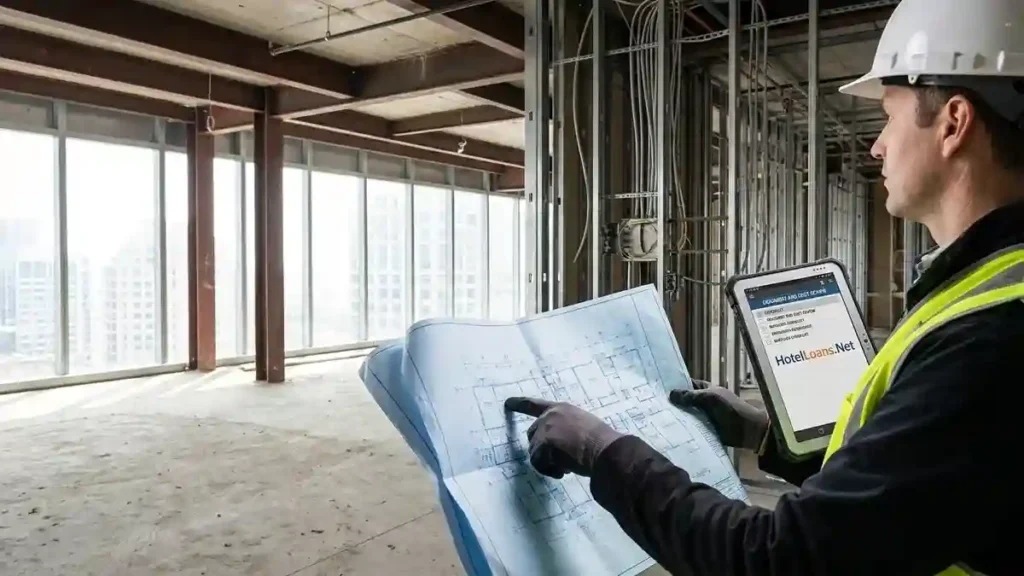
Doing the right due diligence for hotel construction loans is more than a checklist. It is a deep dive into the “Document and Cost Review.” Seasoned engineers must visit the site. They verify that the work you pay for is actually finished. This prevents “cost-to-complete” deficits.
Vetting the furniture and equipment is just as critical. High-end public spaces in luxury hotels have massive lead times. You often have to pay 50% deposits 12 months before delivery. If your due diligence misses these orders, your grand opening will slip. We also perform “reputational due diligence.” Trust is the currency of the 2026 market. One bad partnership can sink a $50 million project.
Why you need financial modeling for hotel construction risk

Modern financial modeling for hotel construction risk is 300% more complex than it was a decade ago. Harvard Business Review notes that models now include multi-scenario planning. We use Monte Carlo simulations to run thousands of possible outcomes. This helps us understand the probability of success.
Lenders look at two main numbers. First is the Debt Service Coverage Ratio. We want to see at least 1.25x. Second is the Debt Yield. A target of 10% on a stabilized hotel is standard now. This accounts for interest rates that remain “higher for longer.” We stress-test your model against rising labor costs. If your profits drop by 10%, does your loan stay in compliance?
Can you manage the impact of interest rates on hotel construction financing risk?

The impact of interest rates on hotel construction financing risk is the biggest wildcard today. While rates are stabilizing, they are not returning to the ultra-low levels of the past. High rates increase your “carrying cost.” Every month of delay adds hundreds of thousands of dollars in interest expense.
Lenders are stricter with “cost-to-complete” tests. We also watch the $1.8 trillion in commercial mortgages maturing in 2026. This creates a “refinancing gap.” You must ensure your construction loan has a clear exit strategy into a permanent loan. Projects with “clean” documentation and strong sponsors earn tighter interest spreads even in a high-rate environment.
Legal aspects of hotel development financial risk
Ignoring the legal aspects of hotel development financial risk leads to litigation. We focus on “indemnification” clauses. These shift liability for accidents or delays to the responsible party. Liquidated damages are also becoming more aggressive. If a contractor finishes late, they pay for your lost room revenue.
Human trafficking liability is a new legal risk. Insurers now scrutinize hotels near airports or major highways. You must show a plan for staff training and guest safety to get approved for financing. We also check “Brundage Clauses.” These allow lenders to accelerate your loan if tax laws change. Clear contracts are your best defense against project failure.
Why do so many projects fail? (Case studies hotel construction financing failures)
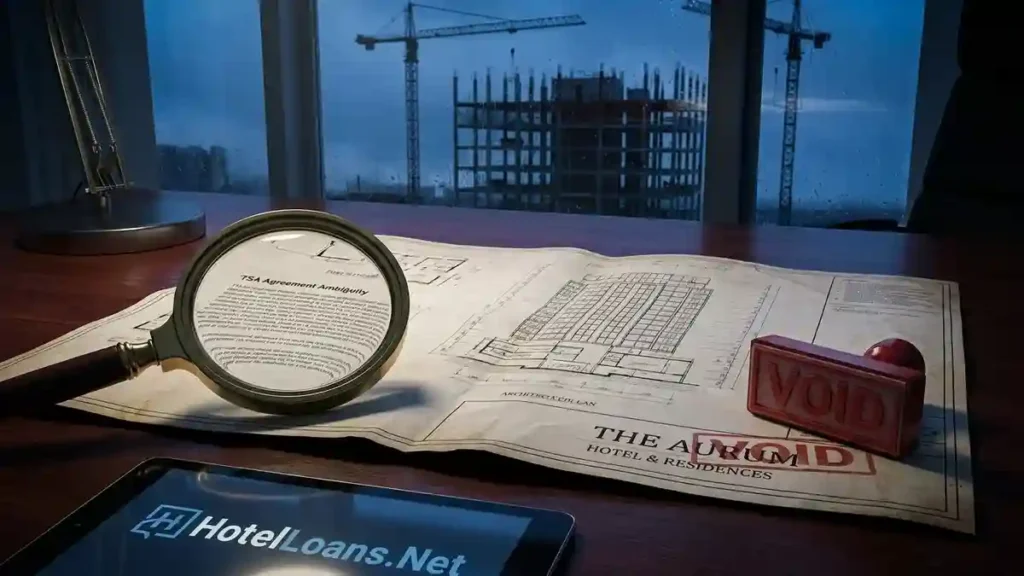
Looking at case studies hotel construction financing failures reveals common traps. The Castillo Grand failure happened because the design guide mentioned in the contract did not actually exist. This led to subjective reviews and arbitrary reversals. The project lost its brand and faced massive cost overruns.
Another example is the St. Regis Fort Lauderdale. Disputes over design and construction standards resulted in the loss of the brand. This caused years of delays and higher debt service costs. In the 1990s, over 2,000 hotels filed for bankruptcy because of high-debt models. Today, we prefer the conservative approach. High debt yields and strong interest coverage keep you solvent through the business cycle.
A developer guide to hotel project risk assessment
This developer guide to hotel project risk assessment focuses on efficiency. You must protect your margins. Do not over-build features that guests will not pay for. In a market where RevPAR growth is flat, every dollar of construction cost must generate a return.
Consider “conversion opportunities.” Repurposing an old office building or an underperforming hotel is often faster than a 23-month ground-up build. You also need digital transparency. Using real-time data for draw requests builds trust with your lender. This execution certainty is more valuable than leverage in 2026.
Best practices for hotel construction financing risk
Following best practices for hotel construction financing risk requires a “Risk Breakdown Structure.” This categorizes risks into technical, external, and managerial buckets. You should always have a contingency budget and a time buffer. This protects you from the inevitable disruptions in the supply chain.
ESG (Environmental, Social, and Governance) targets are now a best practice. Lenders factor your energy efficiency into the loan pricing. Major corporations require sustainability data before they book your hotel for business travel. Building a “green” hotel is no longer a choice. It is a way to future-proof your asset and secure better financing terms.
Understanding pre-construction risk hotel financing
You win or lose a project during the understanding pre-construction risk hotel financing phase. This is when you vet the “buyout status” of your materials. If your glass and steel are not locked in at a fixed price, your budget is just a guess.
Branding risk is the other pre-construction hurdle. You must have brand approval for your design documents before the loan closes. We track these milestones diligently during the first 12 months. Most critical approvals for public spaces must happen early to avoid cascading delays. If you don’t have a “GMP-ready” project, most traditional banks will walk away.
Insurance solutions for hotel development financial risk

Modern insurance solutions for hotel development financial risk go beyond basic coverage. Property insurance is getting harder to find in high-risk zones. You must show “risk maturity.” This means installing hurricane-resistant windows or water sensors to lower your premiums.
Cyber risk is also a major concern. As hotels adopt AI for guest check-in, they become targets for hackers. Cyber liability insurance is now a standard requirement for most construction loans. We also recommend “business interruption” insurance. This protects your cash flow if a disaster prevents you from opening on time.
Which model fits your project? (Comparing risk models for hotel construction finance)

When comparing risk models for hotel construction finance, look at your goals. Traditional banks use an asset-based model. They focus on the liquidation value of the property. Private equity and super brokers like HotelLoans.Net use “forward-looking” models.
| Model Type | Primary Focus | Best For |
| Asset-Based | Collateral value | Traditional Banks |
| Contingency Theory | Handling disruptions | SBA & Construction |
| Operational Excellence | Efficiency and NOI | Table Lenders |
| Value at Risk (VaR) | Exceptional loss potential | Private Equity |
The “Contingency Theory” model suggests that project success depends on how you handle disruptions. We focus on “execution certainty.” We look for projects with clear scopes and reliable subcontractors. This model helps us navigate the “bifurcated” world of 2026, where luxury thrives while economy segments struggle.
The strategic path forward
Success in 2026 requires a mix of 30 years of intuition and real-time data. The U.S. economy is growing at a modest 2% rate. World Cup 2026 events will boost RevPAR by another 2% in host cities. This creates a window of opportunity for developers who can manage their costs.

HotelLoans.Net offers the consulting and underwriting expertise you need. We provide 75 loan options for hotels, motels, and resorts. We help you through land purchase, construction, and permanent financing. We do not run your business, but we ensure your capital structure is built to last.
Expert risk assessment in hotel construction financing is the only way to protect your legacy. You must be “ruthless” with cost control. You must advance your risk maturity. By focusing on execution and capital efficiency, you can turn today’s market challenges into tomorrow’s premier assets. Let’s build something that stands the test of time.
FAQs
Can modular construction lower project financing risk?
Yes. Modular building reduces total construction time compared to traditional methods. This decreases interest carrying costs and gets your hotel open faster. Lenders value the quicker path to revenue and the lower exposure to unpredictable on-site weather or labor delays.
Does daytime utilization improve your loan terms?
Yes. Marketing rooms for daytime workspace can increase ancillary spending by 40%. Lenders view this as a strategic way to cover fixed operational costs while rooms sit empty. It builds a more resilient cash flow model for your debt service.
Will wellness trends boost your project value?
Yes. Wellness tourism will top $1 trillion globally this year. Hotels focusing on mental health or longevity concepts command higher room rates. This high demand improves your net operating income and makes your property more attractive to institutional capital.
Do hybrid leases protect your debt service?
Yes. These structures pair a fixed base rent with performance-based income. They provide a reliable floor for your loan payments while letting you benefit from market growth. Lenders prefer this balance because it stabilizes the project during slower travel seasons.
Can KYC issues delay your financial close?
Yes. Beneficial ownership checks and identity verification stall 80% of project financing today. These delays often lead to compressed construction schedules and higher costs. Addressing compliance requirements early ensures your deal moves from mandate to funded without losing critical timing.