The hospitality development landscape in 2026 is defined by a paradox: record-breaking capital availability competing against the most selective underwriting environment in three decades. As the industry navigates a massive $936 billion wave of debt maturities, developers are discovering that securing a large hotel construction loan requires more than just a prime location; it requires a sophisticated capital strategy.
At HotelLoans.Net, we bring 30 years of underwriting abilities to this complex market. Our platform connects you with 200 private lenders and investors and 75 different loan options. Whether you are building a luxury resort or a boutique urban destination, we provide the economic consulting and lending power to turn your blueprint into a stabilized asset.
Is the $936 Billion Maturity Wave a Crisis or a Development Opportunity?
In 2026, the commercial real estate sector faces a monumental milestone. Approximately $936 billion in loans are reaching maturity, representing an 18.8% increase over 2025 levels. While some see this as a “debt wall,” seasoned developers view it as a catalyst for new large scale hotel project financing solutions.
Lenders who extended loans in 2024 and 2025 are now seeking “take-out” financing or recapitalization. This shift has opened the doors for entrepreneurial sponsors to secure commercial real estate loans for large hotels that were previously locked in stagnant portfolios. With US GDP growth projected at 2.3% for 2026, demand for high-quality lodging remains resilient, provided the capital stack is structured to handle current interest rate realities.
How to Get a Large Hotel Construction Loan: The 2026 Playbook
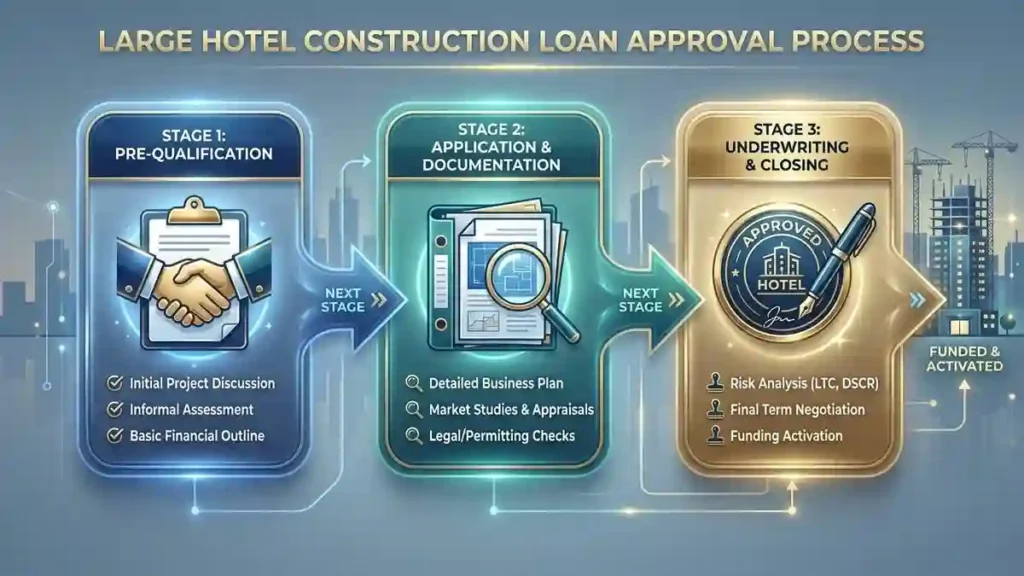
Securing a multi-million-dollar commitment involves a rigorous, large-scale hotel construction loan application process. Lenders are no longer just looking at pro formas; they are scrutinizing asset-level execution. To move from application to closing, your project must demonstrate “semantic completeness”—a clear, data-backed narrative that justifies every dollar of requested capital.
Primary Requirements for Large Hotel Construction Financing
Qualification starts with transparency. Lenders today prioritize sponsors with a “flight to quality” mindset. Key requirements include:
Verified Sponsor Track Record: Lenders target operators with proven management experience and a net worth greater than the loan amount.
Post-Closing Liquidity: You must typically demonstrate liquidity of at least 10% of the loan amount to absorb potential cost overruns or market fluctuations.
Independent Feasibility Studies: A third-party analysis of market demand, competitive supply, and RevPAR projections is non-negotiable.
Brand Approval: For flagged properties, documentation demonstrating compliance with the franchise agreement and Property Improvement Plan (PIP) details is essential.
Fixed-Price Contracts: To mitigate the risk of rising material costs, lenders prefer Guaranteed Maximum Price (GMP) contracts.
Why Are 58% of Guests Abandoning Standard Rooms for Luxury Stays?
One of the most startling shifts in 2026 is the “luxury leap.” Data indicates that 58% of travelers now choose superior or luxury accommodations over standard rooms, a significant 4-percentage-point increase from previous years. This shift in consumer behavior is driving a surge in large luxury hotel development loans.
Financing the Large Boutique Hotel
Travelers are increasingly seeking unique, experience-led stays rather than cookie-cutter environments. Consequently, large boutique hotel construction financing options are expanding. These projects often command higher Average Daily Rates (ADR), which appeals to private lenders looking for premium yields.
However, boutique projects face unique large hotel development loan risks. Without the “safety net” of a major brand flag, independent hotels must prove their market-capture ability through aggressive digital marketing and superior operational design.
Can Your Project Survive the “10.5% Debt Yield” Test?
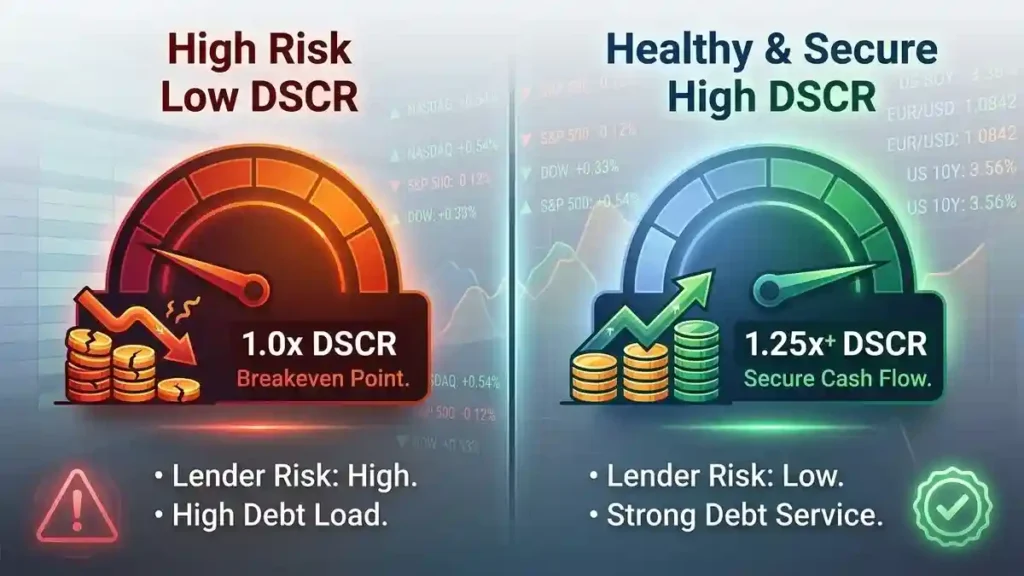
In 2026, the “gold standard” for underwriting is no longer just the Loan-to-Cost (LTC) ratio. Lenders are laser-focused on the Debt Yield.
Debt Yield = ({Net Operating Income (NOI)}/{Loan Amount}) * 100
For the strongest large luxury hotel development loans, lenders typically require a minimum debt yield of 10.5% to 12%. If your project falls below this threshold, you may need “rescue capital” or mezzanine financing to fill the gap in your capital stack.
Key Lender Metrics for 2026
Metric
Target Range
Purpose
Global DSCR
1.25x or higher
Evaluates the sponsor’s entire portfolio health.
Loan-to-Cost (LTC)
55% – 65% (Banks)
Measures the lender’s exposure relative to build cost.
RevPAR Index
100+
Compares your hotel’s performance to its local competitive set.
Interest Rates
6.75% – 10%
Varies by leverage, asset type, and lender risk appetite .
Best Lenders for Large Hotel Construction Loans: 2026 Rankings
The lending market is currently bifurcated. While traditional banks are opening up for “top-tier” borrowers, private debt funds are providing the bulk of the flexibility for complex developments.
Top 10 Traditional Banks by Construction Loan Volume
According to S&P Capital IQ data, these institutions remain the largest providers of construction debt, though they typically cap leverage at 65% LTC :
Wells Fargo: $22.45 Billion
JPMorgan Chase: $14.89 Billion
Bank of America: $12.16 Billion
Bank OZK: $11.65 Billion
U.S. Bank: $10.91 Billion
Truist Bank: $8.22 Billion
M&T Bank: $7.75 Billion
Citizens Bank: $7.37 Billion
Citibank: $6.44 Billion
PNC Bank: $6.20 Billion
Private Lenders for Large Hotel Construction Loans
For developers seeking higher leverage (up to 75% or 80% LTC) or non-recourse terms, private lenders are the preferred choice.
Peachtree Group: Offers $15M to $150M for ground-up construction, with rates typically ranging from SOFR + 5% to 9%.
HALL Structured Finance (HSF): Specializes in non-recourse hotel construction loans for flagged and boutique properties nationwide.
AVANA Capital: Known for 45-day closings and specialized programs for branded hotels.
Navigating Large Hotel Development Loan Risks in a Volatile Economy
Building a multi-million-dollar asset in 2026 requires a strategy to address “deepening divisions” in the construction market. While total construction spending is up, cost pressures from trade policies and labor shortages are intensifying.
The Labor Squeeze and Material Inflation
The industry is currently facing a structural shortage of tradespeople, amplified by aggressive immigration enforcement in major metropolitan markets. This labor shortage directly increases wage premiums and extends project timelines. Simultaneously, tariffs have pushed copper prices up by 40% in recent cycles, while steel and aluminum remain subject to a 50% tariff.
Tips for securing large hotel construction debt amidst these risks:
Early Contractor Engagement: Bring your construction team in during the pre-development phase to refine budget assumptions.
Dynamic Risk-Sharing: Use contracts that allow for shared savings or transparent contingency management.
Inflation Hedging: Consider “Builder Best Extended Rate Locks” to keep interest rates stable for up to 12 months during the build.
Is the USDA B&I Loan Better Than an SBA 504 for Your Project?
For projects in rural or secondary markets, government-guaranteed programs offer lower equity requirements and longer amortization periods.
Large Resort Hotel Construction Funding: The USDA Advantage
For urban developments, the SBA 504 program remains the gold standard for long-term fixed-rate stability.
Equity: As low as 15% for “special-purpose” properties like hotels.
Structure: A bank provides 50% of the cost, and a CDC provides 40% via a fixed-rate debenture.
Energy Incentive: Projects that reduce energy consumption by 10% can qualify for multiple loans under the “Green” program, effectively allowing for larger total project sizes.
Qualifying for Multi-Million Dollar Hotel Construction Loans: The Underwriting Deep Dive
Lenders in 2026 are using “recession-light” underwriting assumptions. They are looking beyond your pro forma to see if you can absorb a downturn.
Large Hotel Pre-Development Loan Criteria
Before a lender commits to the “vertical” build, they often scrutinize the pre-development phase. This includes:
Entitlement Status: Are all zoning variances and permits in place?
Equity Injection: Lenders want to see the sponsor’s “skin in the game” early. Typical equity injections for construction now range from 20% to 35% of total costs.
Global Cash Flow (GCF): Underwriters will aggregate the income from all your existing properties to ensure your “financial ecosystem” is healthy.
Referral Programs: Helping Brokers Succeed in Hospitality Real Estate
HotelLoans.Net isn’t just for developers; we are a strategic partner for hospitality real estate brokers. We offer both exclusive and non-exclusive referral programs designed to help you close more deals.
Financial Advice for Hospitality Real Estate Brokers
Whether you are an experienced broker or new to the industry, our platform gives you access to 75 different loan options to present to your clients. From purchasing land for hospitality property to financing a complex “fix and hold” strategy, we provide the underwriting horsepower you need. Our economic consulting services ensure that your clients enter the market with a capital stack optimized for growth, not just survival.
Conclusion: Building the Future of Hospitality
In 2026, building a hotel is an act of “strategic resilience”. The $936 billion maturity wave and the shift toward luxury experiences have created a market that rewards preparation, credibility, and data-driven decision-making.
At HotelLoans.Net, we specialize in large scale hotel project financing solutions. With our 30 years of experience and connections to 200 private lenders, we bridge the gap between your vision and the capital required to realize it. Whether you are seeking a bridge loan to navigate a renovation or a multi-million dollar construction loan for a new resort, we are here to ensure your dream becomes a reality.
Ready to build? Contact HotelLoans.Net today to receive a customized quote for your next hospitality investment property.
FAQs
Can rural hotels secure large construction loans?
Yes. The USDA B&I program provides up to $25 million for projects in areas with populations under 50,000. These loans offer longer terms, typically up to 30 years, helping developers manage monthly cash flow effectively in secondary markets.
Does demand for luxury travel attract private lenders?
Yes. Lenders are currently targeting large luxury hotels due to high demand from travelers. Recent data shows 58% of guests now prefer superior or luxury rooms, making high-end assets top targets for institutional capital and private lenders.
Is 10% down enough for hotel construction?
No. For most hospitality projects, equity requirements typically range from 20% to 40% of the total project cost. However, expanding an existing business through the SBA 504 program may allow a down payment as low as 15%.
Can energy efficiency unlock multiple hotel loans?
Yes. The SBA 504 Green program allows developers to finance multiple hotels if projects reduce energy consumption by at least 10%. This structure provides long-term fixed-rate stability, serving as an effective hedge against persistent inflation.
Do branded hotels have exclusive financing programs?
Yes. Some lenders offer specialized co-lending programs, such as the AVANA-IHG partnership, designed specifically for qualified branded hotel developers. These solutions provide streamlined capital for ground-up construction, brand conversions, and major capital improvement programs for experienced sponsors.
Facebook Twitter Pinterest LinkedIn An independent motel renovation loan pays for repairs at a motel with no brand. Lenders look at your cash flow, your
Facebook Twitter Pinterest LinkedIn Old rooms lose guests. Fast. A tired lobby, worn carpet, or a noisy air conditioner sends travelers to the motel next
Facebook Twitter Pinterest LinkedIn Commercial real estate is heading into a heavy refinancing stretch. The Mortgage Bankers Association reports that roughly $875 billion in commercial
Facebook Twitter Pinterest LinkedIn Right now, unrenovated hotels are losing up to 39% of their potential income while new construction costs surge past $742,000 per
Ready to Discuss Your Hotel's Financial Strategy? Need a Commercial Loan?
Contact us today at Hotel Loans to initiate a conversation about how our financial expertise can contribute to the success of your hotel business. Our experienced team will be happy to help you.


 Google AI
 ChatGPT
 Perplexity